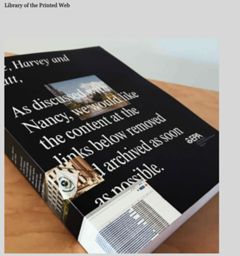
"Library of the Printed Web is a physical archive devoted to web-to-print artists’ books, zines and other printout matter. Its mission is to provide an in-depth view of network culture, artistic practice, and the printed page. The collection is an important resource for the study of print-based experimental publishing in the early 21st century. The collection was acquired by The Museum of Modern Art Library in January 2017, where it is fully accessible for viewing and research (by appointment)."--'About' page.
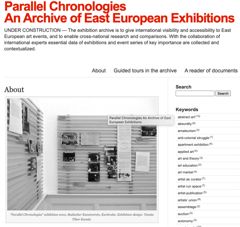
"The aim of the online exhibition archive is to create a common knowledge and discourse around the history of various curatorial and artistic practices within the Eastern-European art scenes. Our goal is to present an international network of professional relationships, documents of exhibitions, events, and art spaces instead of merely displaying artworks. We also attempt to propose a methodology with which documents and factual information, as well as legends and cults can be researched, processed, and shared. We are focusing on the period determined by different versions of state-socialisms and capitalisms, political control of official art events, and the development of a parallel culture that incorporated a network of very heterogeneous dissident positions defined on the level of ideologies, art movements, or life-styles. The time-frame of the archive is not set with exact dates as they are slightly different in every country. We wish to trace and introduce new methodologies that can incorporate the particularities of the art events realized in these specific circumstances into the international discourses around exhibition theories."--'About' page.
"An open-access journal devoted to progressive scholarship on medieval art.
Different Visions aims for inclusive publishing and welcomes a variety of approaches and topics reflecting the diversity of medieval visual and material culture. It publishes work that engages with all forms of critical theory, including Premodern Critical Race Studies, Gender Studies, the global Middle Ages, and Medievalism. The journal also seeks integrated, socially-engaged, or pedagogical projects that examine the role of medieval visual culture in our contemporary world. In addition, the journal welcomes projects that work at the intersection of medieval art history and the digital humanities. Unlike a traditional print journal, the e-format of Different Visions accommodates dynamic and interactive new media. We invite submissions that include digital content, including but not limited to film and audio clips, three-dimensional models, and gigapixel and spherical panoramas."--About page.