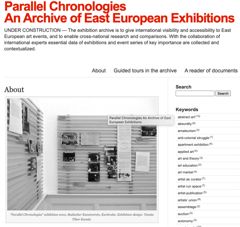
"The aim of the online exhibition archive is to create a common knowledge and discourse around the history of various curatorial and artistic practices within the Eastern-European art scenes. Our goal is to present an international network of professional relationships, documents of exhibitions, events, and art spaces instead of merely displaying artworks. We also attempt to propose a methodology with which documents and factual information, as well as legends and cults can be researched, processed, and shared. We are focusing on the period determined by different versions of state-socialisms and capitalisms, political control of official art events, and the development of a parallel culture that incorporated a network of very heterogeneous dissident positions defined on the level of ideologies, art movements, or life-styles. The time-frame of the archive is not set with exact dates as they are slightly different in every country. We wish to trace and introduce new methodologies that can incorporate the particularities of the art events realized in these specific circumstances into the international discourses around exhibition theories."--'About' page.
"An open-access journal devoted to progressive scholarship on medieval art.
Different Visions aims for inclusive publishing and welcomes a variety of approaches and topics reflecting the diversity of medieval visual and material culture. It publishes work that engages with all forms of critical theory, including Premodern Critical Race Studies, Gender Studies, the global Middle Ages, and Medievalism. The journal also seeks integrated, socially-engaged, or pedagogical projects that examine the role of medieval visual culture in our contemporary world. In addition, the journal welcomes projects that work at the intersection of medieval art history and the digital humanities. Unlike a traditional print journal, the e-format of Different Visions accommodates dynamic and interactive new media. We invite submissions that include digital content, including but not limited to film and audio clips, three-dimensional models, and gigapixel and spherical panoramas."--About page.
"
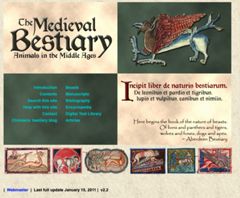
This web site deals with any and all aspects of the general topic "animals in the Middle Ages", though there is an emphasis on the manuscript tradition, particularly of the bestiaries, and mostly in western Europe. The subject is vast, so this a large site, with well over 3000 pages, and perhaps the best way to explore it is to just wander around." --Introduction page.
"Marking the Museum’s entrance into online publishing, Altered States: Etching in Late 19th-Century Paris combines a scholarly collection of essays with a video glossary of printmaking techniques. The online publication compliments the exhibition by the same name that was on view at the RISD Museum June 30 –December 3, 2017.
In late 19th-century Paris, the printmaking process of etching underwent a revolutionary transformation. At a time when prints were usually made as copies of paintings rather than as original works of art, a revival of interest in etching led to greater knowledge of technique, allowing artists to experiment with subject matter and process more than ever before. The publication focuses on the creativity and experimentation that proliferated in these years, during and after etching’s revival, and the centrality in this important shift."